Becoming a bestseller would be many an author’s greatest fantasy. But, is there a formula?
Some would argue that focusing on becoming a bestseller is like shooting yourself in the foot–you’re not going to become something you’re chasing after by focusing exclusively on that object you’re chasing. That is, focusing on writing a bestseller means you’ll be too concerned when writing on how to make that book a bestseller that you’d ultimately fail because you’re focusing on the wrong things.
Others argue that there are distinct features of bestsellers, characteristics that make it “easy” to understand what makes the book and readers tick, and lands that book on a bestseller list.
In doing some research on what makes books bestsellers, and reading up on expert opinions, I found an NPR article that seemed to distill bestseller features into a 12-item list. Here are some features of that list:
The book focuses on some major issue of its time, e.g. race in Gone with the Wind, or politics in The Hunt for Red October.
Broken or fractured families and relationships
Protagonists who are outsiders to whatever society they live in or what to become part of.
The American Dream, whether praised or condemned, is a motif of the books.
Secret societies, e.g. The Da Vinci Code, and even Twilight, with its secret vampire societies.
Wishful thinking, a la Fifty Shades of Grey.
Power to connect with readers through mind, heart, and gut. That is, you have to appeal to the intellect, the emotions, and the senses of readers. This, I’d say is the key.
Doing some more research, I found an article listing out what John Baldwin discovered of bestsellers. He was struggling, but was determined to write a bestseller, and took to studying books that had already made the list. What he found was that bestsellers tended to have these characteristics in common:
The hero is an expert. It could be magic, weapons, love, whatever the book centers on.
The villain is also an expert.
The villainous parts of the book have to be seen from the villain’s POV.
The hero has to be backed up by experts of other fields. This makes me think of the show, Arrow, where the main character, Oliver, has a team made of up Felicity Smoak, John Diggle, and others that come on as the show proceeds.
Those on the team must fall in love with each other, at least one couple.
At least two of those on the team must die.
The villain has to turn his attention to the team, away from his original intentions.
Both the hero and the villain have to be alive to battle each other in the sequel.
Any deaths have to progress from individuals to groups. You can’t say that xxx amount of people died in the plane crash; you must start out with “Jack and Jill died as the plane exploded,” and then move on to the group as necessary.
When the plot begins to stale or hit a block, kill somebody off.
However, this list can be applied to both bestsellers and selling failures. At the end of the day, it is creativity, uniqueness, and a melding of genres into a mix that make the best books. I think the more human the book, the better. Human can mean different things to different people, but the more relatable, the more emotional, the more depth, and the more expression a book contains, the better it will be enjoyed for generations to come.
*Note: This article was originally published on January 12, 2016.
I read Jeff Gerke’s “The First 50 Pages,” and of course, half the book is highlighted. Since I found the book to be useful, and I learned a lot reading it, I decided to outline some of the main points of the book.
“We have to engage your reader, first and foremost. You have to introduce your hero…establish the context of the story…reveal the genre and milieu and your story world…set up the tone of the book…presenting the stakes, introducing the antagonist, establishing the hero’s desires, starting the main character’s inner journey, and getting a ticking time bomb to start ticking down.”
That’s a lot to do in the first 50 pages…
“A weak first line is a killer. You get only one first line, so make sure it’s carefully thought-out.”
“…don’t start your novel with a dream.”
“Your opening line must hook your reader. You must start with action. But that doesn’t mean you have to have a battle scene or anything that needs to blow up. It simply means it must be interesting to the reader.”
“Good dialogue is…layered. In theater, it’s called subtext.”
“In good dialogue, dialogue with subtext, the characters aren’t responding to what the other person says, but to what they think the other person means.”
“Give your dialogue subtext, and it will be easier for agents and editors–and readers–to love your novel.”
“Fiction is conflict: someone who wants something but is prevented from getting it…The acquisitions editor is looking for signs of conflict in your first fifty pages.”
“…three main craft errors that most often cause agents and acquisitions editors to reject fiction proposals…The big three bombs are telling instead of showing, point-of-view errors, and weak characters.”
“…information dumping is called telling. Its main forms are backstory, pure exposition, summary/recap, and the explanation of character motives.”
“When you load your story with telling, you deprive your reader–and even your characters–of the joy of having it all happen experientially. Take the information out of the voice-overs (your telling) and put it into the scenes.”
“…there are only two things you must do with your first fifty pages, only two large-scale tasks…:
You must engage your reader. That is Job One. And you must set up your story so the rest of it will work correctly.”
*Note: This article was originally published on January 2, 2017.
As of September 7, 2021, I have officially signed with a literary agent! Kaitlyn Johnson of Belcastro agency will represent me in getting my latest novel published!
Kaitlyn has a lot of experience in submitting to the Big 4 publishers, and I have no doubt she and I will be a successful partnership!
A couple weeks ago, I shared the good news about being offered lit agent representation for my jinn necromancer novel.
A second agent reached out to me to offer representation!
This may seem like a dream, and for about one second, it was. But it’s rather stressful choosing between two amazing agents, who are both so driven and intelligent. It comes down to small (big) things and what I end up wanting in an agent. And even then, I have no guarantee I’ve made the right decision. It feels like, in gaining one kilo of gold, I’m losing another kilo of gold.
Ultimately, it comes down to who will push your career farther, in less time. Or so I’ve determined.
The novel I’ve been working on the last 3 years, about a necromantic jinn and her daughter, has been offered representation!
I started querying in June/July, and sent my queries to 80+ agents, with 5-6 requests for partials and fulls. But yesterday, glorious yesterday, an agent Zoomed me to offer representation!
Nothing’s official yet, but this is the best news I’ve had all year!
She did offer revisions, but she said my manuscript is clean enough that it won’t need that much work before she can sub it to publishers.
The beast bit me and I sat down to start a gothic novel. I started about a week ago, and I’m about 19 chapters, and 92 pages in. Needless to say, I’ve been swallowed by the premise and I feel as if, if I were the reader, not the writer, I’d read this book. And that’s always a good sign.
The inspiration is a mix of Jane Eyre and The Fall of the House of Usher. It’s about a college student, Jade, who drops out of college after she finds another student murdered near campus. At first, the police suspect her, but they quickly decide she’s innocent. The rest of the students, and the town, however, have their reservations, though. So Jade decides to take a job at a creepy old house 4 hours away from home.
Here’s an excerpt from first chapter. Let me know what you think in the comments!
Chapter One
“Storyteller for hire. Must be good with adults. Pays well. Call 439-7920.” The newspaper ad is short and simple, and it strikes me as off, but I ignore everything except the “Pays well.”
I’m at $39.79 in my bank account, and I’m desperate for a job. Any job. This college thing isn’t working out. Who needs physics, and calculus, anyway, no matter what my mother says about what she calls “femininst power jobs.” Show the man the woman can.
I cross the street to the payphone and pull out a quarter before dumping it into the phone’s slot with a clank. The sky is a pale blue, light gray really, and there’s a smoky black cloud in the distance strangling half the sky.
4-3-9-7-9-2-0.
I hear the line ring, once, twice, then a gruff, “Sever House.”
“Uh, yes, hi, hello,” I stammer. “I saw an–your ad, in the paper?”
I pause, but all I hear is breathing on the other end.
“Um, well, the storyteller–”
“Yes,” the voice interrupts. I can’t tell if it’s a woman or a man, but I think it’s a woman who smoked ten too many cigarettes.
“I, uh, yeah, I’m interested.”
“Can you tell stories? Good ones? To adults? Nothing too bloody, though.”
“I–I’ve babysat–”
“I’m asking about adults. Not children. Children’s stories are easy. Adults, well, that’s a different beast.”
“Uh, well, I can interview? Maybe?”
I hate how I sound, unsure, uncomfortable. I need to run with the wolves more.
I clear my throat and stand up a bit straighter, even though the voice on the other line can’t see me. I spot my reflection in the payphone’s metal paneling, though, and I force myself to smile.
There, that’s better. A smile goes the extra mile. Another one of mom’s “self-improvement” quotes.
“I can come in and interview and–”
“Do you have samples?”
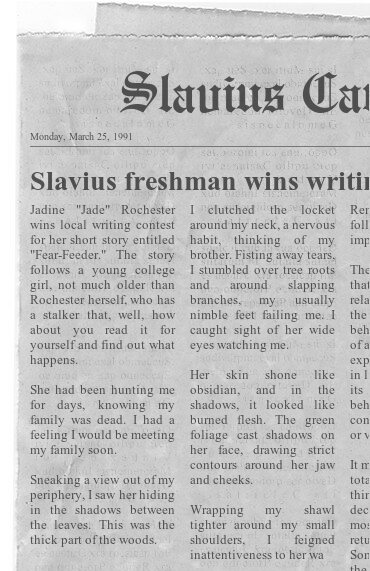
“I-actually, yes. I do. I won a local writing contest, and I can send you the newspaper clipping.”
“Do you have an email account?”
“Uh, yes, I–”
“Fax the clipping, I’ll take a look. I will send you an email with the contract if the writing is up to our standards.”
“Oh ok, yes, thank you. Uh, and where’s the House, exactly?”
“I can send you the address via email and a contract to look over. I’ll want a signed copy of the contract before you come. The position is for an in-house storyteller. You will live at the house for the duration of fall and winter, and then you may leave. The Master of the house prefers his stories with tea and digestives, sometimes with a little brandy in the tea.”
“Check tonight for an email. If there is none, you did not get the job,” the woman says. I hear static and a groan, and then she adds, “You may send a fax to 763-3663.”
The line goes dead and I’m left holding a phone. I place it back on the receiver and, with a smile, I cross the street back to the daycare I’ve been working at.
If I can win a short story contest, I can get this job.
I visualize myself giving the daycare my notice, then shake my head of the thought. You don’t even know what the pay is for a storyteller. It’s probably less than the daycare.
Even so, I can’t help but feel a tinge of excitement. I’m getting out of here, I’m getting away from this place.
“I’ve gotten a new opportunity,” I whisper to myself, before I step back inside. “I am giving my notice.”
I take a deep breath.
“I’ve gotten a new opportunity, and this is my notice.”
I shake my head to clear the thought.
“I got an offer for a new job, and I’ll be taking it. Thank you so mu–”
“Jadey?”
I wheel around to find Kirsten staring at me.
“I–wasn’t talking to myself,” I say.
She stares a moment too long then says, “Right. Want to come back inside?”
“Uh, yeah, actually, I wanted to talk to you.”
“Can it wait? Jeremy’s mom is coming in today to talk about his “milestones and development,” Kirsten says, rolling her eyes. “She thinks we should be doing more to ‘develop his young brain,’ she adds, air quoting with her fingers.
“What does she expect?” I say, stepping back into the clangs and noises and gurgles of babies. “I mean, we’re a daycare, not even a preschool.”
“I know,” Kirsten says. “But, the parents pay the monies, and therefore the bills.”
The door opens behind us. A tall woman with mom jeans and t-shirt steps inside. “Candice,” Kirsten says with forced cheerfulness in her voice. “Jermey’s right there with Candice,” she adds, pointing in the center of the room where a short brunette is pressing buttons on a musical book with 9-month-old Jeremy. “Come into my office just around the corner,” I hear Kirsten say as she’s already leading Candice away.
I sigh, and turn back to the stack of paperwork I need to file.
I hear Kirsten’s too-cheery voice again when she opens her office door. Two sets of footsteps walk down the short hall back to the main office and playroom of Kirstie’s Care.
“I’ll be taking Jeremy home today,” I hear Candice say, “But I’m thrilled we’re on the same page.”
Cooing and ahing ensue as Candice moves to pick up Jeremy off the ground. He blows bubbles and Candice snuggles her nose against his. Candice flicks her eyes at me, and recognition registers. I notice she clutches Jermey hard enough that he squirms in her arms, and she shields his body a bit with hers.
“You’re that girl–” she starts. “The one in the papers.”
“I’m sorry, I must look like someone else–”
“No, no, I remember your picture. You’re the one that found that poor girl. How awful.”
“It was,” I say.
She leans in closer to me and drops her voice to a whisper. “You really don’t know anything about who did it?”
I swallow a scream and shake my head. “The authorities are still on the case, last I heard.”
She nods once and pulls back from me, still shielding her son’s body with hers. “I’m surprised they let you work here,” she adds.
“I have no criminal record,” I say.
But her eyes narrow at me. “Strange thing, you being the one to find her so late at night.”
“I’m a night owl.”
“I’m sure you are.”
Candice turns to go, the bell over the door jingling behind her.
Kirsten shambles over to me, apparently not having heard what Candice just said. “Can this day get any worse?”
“It’s just a parent,” I say, “You’re always so good with them.”
“Not just her,” Kirsten says, chucking her thumb in the door’s direction after Candice. “The supervisor’s coming and we’re due for a safety inspection.”
“Oh, well, I mean, we’re safe, right?”
“Of course,” Kirsten says, shooting me a dark look. “We just got checked like six months ago. Anyway, it’s been a stressful day, that’s all.”
“Sine you’re here, I’ve been meaning to talk to you.” She chews on her lower lip, and doesn’t quite meet my eyes.
“Oh yeah, what about?”
“You know enrollment has been low recently, and we haven’t been hitting our target numbers.”
I stop shuffling papers and stare at her. “You’re firing me.”
“I’m sorry Jadey. It’s been–well, I can only afford the caretakers right now. You’re a luxury, and a great one, don’t get me wrong, but I just can’t justify the cost anymore. I’m really sorry. As soon as we get our enrollment back up, I’ll hire you right away.”
“And when will that be?” I try to swallow my worry. The other job isn’t a guarantee, and not even Mark’s Market is hiring right now. And I know, because I’ve asked him if he needed an extra cashier, and he said “No.”
“I really don’t know,” she says, frowning. “I wish I knew–”
“It’s fine, I know you’ve been having a tough time.”
“I have been and I hate to drag you into my money woes, but this is where I’m at.”
I smile and hug her. “Thanks for giving me a chance when no one else would.”
“How about you go home,” she adds. “The parents will be here soon, anyway. Sonia, Misha, and I can handle them.”
“You sure?” I say.
Kirsten nods. “You’ve been staying late all week and doing extra. And here,” she adss, going around the desk and unlocking the top drawer. She glances behind her at the other caretakers and hands me an envelope. “Your cash.”
Kirsten’s been paying me cash to help out part-time at the daycare. “Thanks,” I say, and force myself to smile. “Really. I mean it.”
“I know. And,” she says, just as I’m turning to take my coat from the rack, “If you ever need anything–”
“–I’ll ask you.”
She moves to hug me, and I hug her tight back.
“‘Night,” I tell everyone and head home.
Home is just a ten minute walk away, and it’s silent when I open the door.
“Hello?” I call out. “Mom? June?”
Nobody replies as I remember my twin sister Juniper – June – is at the college we go– I went to–, and I lock the door behind me. She was here just last weekend, but left Sunday evening to get back for her classes the next morning. The house is dark and smells like stale incense. I flick on a light switch but even the lamp seems to cast a deep shadow in the hallway.
Outside, it thunders and rain slams against the window.
“Great, a storm,” I say, just as the lights flicker once, twice.
The PC is in dad’s office, the one he used for his architecture work before he died three years ago.
I turn on the computer, listening to it wheeze and whir on until the screen flickers to a blue background, with a picture of the four of us smiling brightly, squinting against the sun, comes up. I try not to make eye contact with any of the faces, even my own. That picture was taken just a month before dad’s car drove off the side of the road in some freak rainstorm when he was coming home from work.
Instead, I move the mouse and double click on the America On Line icon. I wait for the internet to dial up, the whirs and shrieks a bit too loud for the headache that’s come on suddenly.
And so is the fax machine. I quickly pull out the newspaper clipping I keep in his desk drawer.
“Okay, so, it’s this button, right?” I think aloud as I fumble with the fax machine. After some minutes, I figure it out and the fax is on its way.
I wait a few more minutes, puttering away on an internet forum for people who fancies themselves poets. I scroll past the neon colored marquees people have under their names, the ones that trail across the page, with my mouse leaving behind an afterimage of gold stars. The page is bright, using nearly every primary and secondary color, in every hue, especially neon. Everything’s blinking at me, and words keep changing color.
I keep checking my email, waiting for something from the storyteller job, but nothing comes through.
She did say later, didn’t she? Maybe she didn’t get the fax?
I try again, taking the newspaper clipping and sending another fax of it.
The clipping is only a few months ago, but it feels like it comes from another lifetime, maybe even someone else’s life.
There’s a picture of me, with a little blurb of my bio, that I helped write, of course, and there’s a snippet of my story that cuts off before running onto page 4….
The story continues, and at the end, the girl’s stalker kills her and leaves her for dead in a field behind the college the girl attends.
Two days after this article came out, there was a “Special Edition” OpEd on my story. For the rest of the semester, the other students gave me dirty looks, and no one came near me, not even my roommate.
“You think she did it?” I overheard a red-haired girl with a thin braid snaking down her back say. “She knew a lot of the details.”
“They were in the news, though, but maybe she knew the killer? I did hear she found the body.”
“I heard she was covered in her blood…”
I fold the newspaper and slip it back into the desk drawer, ignoring the second clipping with the OpEd tucked inside.
Instead, I go back to the forum I was surfing, reading through the comments about the latest Kurt Cobain song.
But finally, I hear the, “Welcome, you’ve got mail,” and I hold my breath. I double click on the little mailbox icon with the yellow envelope and the email I’m waiting for is right under a *~*ChAiN LeTtEr*~~* email from miss_cleo_sandra_8392. I roll my eyes but make a mental note to open my best friend’s email. She loves sending me those chain emails that say THIS EMAIL HAS BEEN CURSED. IF YOU DON’T SEND IT TO 10 PEOPLE, YOU WILL DIE.
But right under miss_cleo_sandra_8392 is a more severe looking email.
I double click the Job position contract: Please sign and… email and, still holding my breath, wait for it to load. The “contract” reads more like a vintage governess ad from the 1900s than a job contract, but I skim, then read, and then re-read it anyway.
A young woman, with no attachments, university experience in the arts. Quiet, not shy, can talk to people but can be left alone for hours.
This contract hereby commits you to six (6) months of labor as “Storyteller” of Severly House, hereto known as “Sever House” or “the House.”
As “Storyteller,” you will be expected to work Monday through Saturday, with Saturday evenings and Sundays off:
Join at 8-9 o’clock breakfast, prepared with a short story, tale, or fable.
Join at 1-2 o’clock lunch, prepared with a short story, tale, or fable.
Join at 7-8:30 o’clock dinner, prepared with a short story, tale, or fable.
Send to bed with a short story, tale, or fable. Chapter books preferred.
At any time the Master of the House requires a story, one must be proffered immediately.
Passages from books may be read.
Stories told or read must be age-appropriate.
If the Master should request an original tale, one must be proffered immediately.
If the Master should request the presence of The Storyteller at House events, galas, parties, or any such event, the Storyteller must attend and must perform.
If the Master should require any other duties, the Storyteller must perform, within reason, to the best of their ability.
Salary: $13564.66 for duration of six(6) months, to be paid weekly in cash. Lodging and meals provided for. Expected maximum working hours per week at 25 hours, excepting House events, galas, parties, or any such event.
Address: 224 Coven Rd, Sovereign Hill
Ring on the day you are to arrive, preferably by train, and we will have the Driver meet you at the station. Position is available immediately.
Any questions, please address to Amerly Seymour, Head Caretaker of Severly House.
Printed Name: _____________________________
Signature: _____________________________
Date: _____________________________
I quickly calculate the math on the PC’s calculator.
6 months is 24 weeks, and 12,300 divided by 24 is…$565.19 a week, in cash.
With my $9 an hour, and 20 hours per week at the daycare, making $565.19 compared to $180 is more than tempting; it’s three times more tempting. I’d have more than twelve thousand in my bank account after six months, and I’d have food and no rent, and nothing else to pay. Not that I pay for things like that now, but mom’s been freezing me out after I decided to take the semester off, and Juniper’s been sending me way too many emails, trying to guilt me into coming back after all.
Though mom did threaten to make me start paying half the bills because I “dropped out of school,” as she says.
I keep trying to tell her, I didn’t drop out, I am taking a break. But she’s convinced, “Drop the ball and you lose all.”
But why are they paying so much?
And who is this Master?
I decide I don’t care. I’m bored with this town and my life, and I don’t even like kids.
I turn on dad’s old printer, and a couple minutes later, I have the contract laying stark white against the printer tray.
“Here goes nothing,” I say to myself, and sign my name.
Adding emotion to stories can be one of the more difficult aspects of writing. Sure, a writer knows what their characters are feeling, but can they make a reader *feel* the characters’ emotions?
That’s difficult.
I found a great article that was helpful in my own skill-building as I try to better learn how to slow down my writing and make my readers feel my characters.
One thing she says in the article is to “slow it down.”
Counselors tell us that thoughts lead to emotions, and emotions lead to actions. As a writer, you can easily show your character’s thoughts and actions. Readers are smart enough to deduce the emotions based on what the characters think and do. So often it seems writers are in a hurry.
And it’s true. Emotions are processed rapidly, yes, but humans also take time to “study” their emotions, and if not study, certainly to be swallowed by them. So as a writer, it’s important to let your characters feel, and sometimes, drown in their emotions (just not for too long – they do need to surface for air and move on).
Additionally, the article says, “There are two facets of emotion in fiction: conveying what your character is feeling and evoking emotion in your reader.“
Here again, time is king. You need to give your characters the chance to feel and process, and in doing so, you let your reader have the time to imagine themselves as the character.
What do you think is the most effective way to convey emotion? Do you have a favorite book or scene from a book that showcases this skill?
I have written books before–none published as yet, but I’m working on that.
One thing I’ve learned–you can edit your book literally 20 times, and still not have it the way you want it to be. I have experience in this. I revised a manuscript some years back so many times, I ended up with 20 edits, and still wasn’t happy with the way the story flowed, especially since I have written the book as part of a series, and had finished the series in first-draft mode. Every time I sat down to the books to edit, I cringed. Every. Single. Time.
And each revision brought me to the thought, “Ok, I’m done now. It’s as good as it’s going to be at this point.”
But that’s the thing, it’s as good as it’s going to be “at this point.” Six months from now is not “as this point.” It’s six months from this point. And six months makes a huge difference in your perspective on your manuscript and on how to edit it.
Michael Crichton said:
“Books aren’t written—they’re rewritten. Including your own. It is one of the hardest things to accept, especially after the seventh rewrite hasn’t quite done it.”
He’s right. You can have a wonderful story, but that doesn’t mean it flows well and that the technicalities of writing are what they should be. Books are rarely written in first-draft mode and published as is, and become bestsellers. They have to be rewritten, and rewritten, and rewritten, and rewritten again.
So how do you edit your book? Each author has their own method of madness, but many would agree that these steps are critical:
Keep your hands to yourself.
It’s typically a good idea to let your book sit for a while, at least a week, preferably a few months. This gives you a chance to forget about some details, get a fresher perspective, gain new experiences in the time being, and work on other projects. Resist the urge to set fingers to keyboard and begin the editing process.
Distancing yourself is one of the best things you can do when editing your manuscript.
Eye candy.
Give yourself a chance to read through your manuscript, not with the intent of editing it immediately, but to refresh your mind on the story’s details. Sometimes, you’ll find that you wrote something in a scene, but then never used, so it was wasted or irrelevant to your story arc. You can keep a track of details and notes, but don’t worry about editing things right now. You’re a reader here, not a (re)writer.
12’s a charm.
Write a bunch of short synopses of your book—and write 12 of them. Getting a different perspective on your book each time can help you focus on the story itself, especially if you are writing fiction. The goal here is to acquaint yourself with different perspectives that all include the core components of your story. I usually try to create a few scenarios—trying to examine several facets of the story. It’s helpful to do this after you’ve distanced yourself from your manuscript for a while, and then have re-read it.
Kill it with fire!
Start rewriting. Focus with fixing sentence structure, ripping out paragraphs, and even entire chapters. Do this mindfully, with the intention of tightening your writing, and fixing major structural issues within your plot. You have have left out key items, or added erroneous or irrelevant ones. The goal here is to excise and seal.
5. You spin me ‘round…
You’re probably going to go through no less than 3-4 revisions, and most likely are going to rewrite about 10 times—and that’s no exaggeration.
6. …like a record, baby…
You’re going to go through editing again. Focus now on tightening, because at this point, you should’ve fixed the major structural inadequacies of your plot. Worry about removing excess words, making scenes more descriptive, improving dialogue.
7. Mirror, mirror, on the wall!
Worry now about polishing your manuscript. Go through and make sure that sentences are reflecting what you want them to reflect. Make sure your writing is a mirror that reflects what your mind’s eyes see.
8. Beta me this.
Send it to workshop buddies, writing buddies, and friends/family members. Have others critique. Make sure you find people who can be both nice but harsh; they won’t sugarcoat their criticisms and tell you it’s all fine, but they won’t be cruel to you and bring you down. Find as many beta readers as you can—the more the better. Yes, too many chefs spoil the plot, but if a bunch of people are saying the same thing, you can be assured that they’re probably right.
9. Waterproof it.
Give your manuscript one more look-through. Make sure everything’s as tight as possible.
10. Find an agent or publisher!
Between the editing steps, you should let your manuscript sit, for at least a few weeks, if not a few months. Rushing through the steps will get you nothing except an manuscript that stays rough.
*Note: This article was originally published on January 13, 2016.
“Don’t tell me the moon is shining; show me the glint of light on broken glass.”—Anton Chekhov
Descriptions make or break writing. There’s nothing worse than reading a book, and being pulled out of the story by a bland description that seems more passive than active.
One word of advice that I’ve seen multiple times, and have experienced both as a reader and as a writer: the best writing is not about action or character development; it’s about how you are able to make music sing from the words that you write.
Don’t tell me that the violinist played a superb piece; show me how she made the audience cry and find goosebumps on their arms listening to her play.
*Note: This article was originally published on January 17, 2016.
I awake before the sun is bright enough to cut across the horizon to gather the pomegranate seeds – each one a soul who has died in the last day – scattered across the front of my house into a basket, my hands red and sticky with juice.
There are many seeds this morning, and the weight of the basket tilts me as I hobble back inside the cottage.
My daughter is still sleeping in her cot as I sit down, setting the basket on the table. My joints click, a side effect of the curse. I age faster than I should. Already I have white streaks in my hair, and some of my eyebrow hairs are white. Just thirty, but I look a decade older, at least.
The seeds are bright red and plump, and I press them between two pieces of wood and let the juice seep into a bowl. Each seed contains the story of the person the soul belonged to. My job as mutahida, as storyteller, is to tell each soul’s story, to write each soul’s tale. It’s the only way for a soul to leave the waiting place in between life and death, and enter true death, or Mote. Once a soul’s story is told, they can take it to Mote’s gatekeeper and pay for their safe passage where they will have eternal bliss and peace.
When the seeds have been pressed into juice, I take a sip and wrinkle my nose. “Bitter today,” I say to myself, pouring honey into the cup. I stir then take another drink. The stories come in flashes, too quick for my mind to understand, and I’m too tired to try, but my magic is fast enough to catch them.
I see snatches of a river flowing fast and sweep, the brown of a head topped with seaweed floating on. I catch the green of a tree and a swing hanging from a thick branch. I think I hear the growl of a bear. Or the clash of blades. But everything comes too fast, and there are so many stories to tell – stories of days and lives lived. I rarely ever see the last moments of death, thankfully.
I write, my fingers weaving stories in the air, words curling into smoke. I’m a hakawati jinn, and the stories I weave return to death and to the souls they belong to.
I drink more of the juice, weaving smoky tales in the air with my other hand. The stories disappear almost as soon as they form, getting swallowed back into death.
Layala stirs behind me, slipping out of her bed and padding behind me. She says nothing as she sets a pot of tea to boil and begins making our breakfast.
I drink the last of the juice and, more out of habit, glance at the lone pomegranate seed I keep in a small glass jar on a shelf.
Layala’s father. Those who have died by their own hand have no place in Mote. They are banished to jehinam, to suffer eternal cold and perpetual executions.
It was the only love I could show him after his death – to keep him in the waiting place of death, rather than write his tale and send him to suffer.
He visits us sometimes, as happy as any dead could be.
As if thinking about him conjured him, he steps into the cottage, his body more smoke and ash than flesh and blood.
“Illyas,” I say, rising to my feet.
He kisses me, soft and, if not warm, then not the cold expected with the dead. And though his face fades through mine, I pretend I feel his solid flesh.
“Sabah al kheer, baba,” our daughter says, throwing her arms around him. Good morning, father. Her arms collide with his body, the only few minutes of a day he is made of enough flesh to touch, though her skin is streaked with ash when she lets go. I reach out to touch him and he takes my hand.
He can only keep his form a few minutes in a day, in the moments when the sun’s light turns from red and orange to its day colors.
“And how are my girls today?” he says, as he does every visit.
“Good,” Layala says. “I’m going to see jido again today.” Her grandfather.
My dead lover’s face stiffens, but he forces a smile onto his face. “You should spend more time at home, with your mother,” he says, and I throw him a grateful look.
But before Layala could respond, Illyas disappears as the sun’s light breaks through our windows and the morning is fully awake.
We both sigh, always wishing for just one more minute with him.
“I wish we could go into death,” Layala says. “You’re a jinn, you’re made of death itself. Are you sure there’s no way–”
“No, Layl. I’ve told you before. Jinns manage death, they don’t enter it or keep its company, not if they can help it.”
I hate lying to my daughter’s face, but her questions have plagued me for years. Ever since she was a child, she wanted to know: what was death like, was it something you could take trips to?
It’s better she knows as little as possible, even if she is half-jinn. She’ll likely never have my magic, and it’s best she doesn’t.
“I’m going to jido’s,” she says with a sigh. “I’ll be gone all day.”
“Your father is right, you know. You should stay home more, learn a craft so you can support yourself when I die.”
“You’ll be around for many more years, maman. You just don’t like jido much,” she teases, kissing me on my head as she darts off to get dressed.
I glance back at that lone pomegranate seed on the shelf. He’s nothing like his father, and thank the heavens for that.
My daughter leaves the house in a flurry of color and voice. “Bye Maman!” she yells, barely throwing me a parting look. I give her a headstart, grabbing an empty bottle and one filled with honey, and a canteen of water.
Then I take the stony pathway at the back of the house, and head straight for the cemetery. It’s filled with chipped tombstones sporting moss shoulders and spiderwebs. No flowers or notes mark any grave anymore – the cemetery has long been forgotten.
Which is why it’s perfect for my escapes into death. I lean back against a tree and spy a fox watching me.
“Come to see me walk into death, little one?” I say.
The fox cocks its head at me, his snout curled up in a characteristic smile. Then it dashes off, its bushy tail following.
I fill the empty jar with dirt from a grave, mix in the honey and water, and drink the mix. My mouth fills with granules of stone and sand and I try not to chew any, only swallow. The honey does little to mask the taste, but it’ll do.
When the dirt water settles in my stomach, I press my hands to the ground and let the cold of the earth seep into my skin. It’s familiar, this feeling of being one foot in the warmth of life and the other in the cold of death.
My dead lover greets me. He’s a shadow first, then the smoke curls in around him and I can just make out his features. He’s smiling, as usual, his hand outstretched me. I take it and like lightning striking me, my body jolts and my soul is in death.
“Hakawati,” he says, calling me by my title rather than my name. “Hiyati.” My life.
“Illyas,” I say, letting him guide me to a bench. Death surprisingly has small comforts for those who can’t or won’t pass on to Mote or jehinam. “How are you?”
He laughs, the sound gravelly but warm, like honey mixed with sand. I want to hold him like he used to hold me, when he was alive. But bodies move and fit differently in death, less flesh and more ash. “As good as can be. How are my girls?”
“Well enough. Your daughter threw animal shit at some boys who were bothering her yesterday. I don’t know if I should encourage her fiery personality or douse it,” I say, laughing.
Illyas laughs, but there’s a tightness in his face. “She should be careful,” he says. “She’s still your daughter, and they don’t take kindly to that.” He brushes a hand across my face, and though I don’t feel skin, there’s still a trail of warmth. I lean my cheek into his touch, and he lets me rest my weight against him.
“There’s so much I want to tell her,” I say, “But I don’t know if I should. And I’ve told her so many lies over the years. How do I undo that?”
Illyas says nothing, but when he tries to pull me in closer to his chest, we fade into each other, smoke curling into smoke. We pull back, our bodies regaining substance.
“Hakawati, tell her a story. You’ve spun her tales since she was in a cradle, she will feel your meaning, even if she doesn’t understand it. Weave her a story, see what she says.”
“She’ll roll her eyes and ask to go to her grandfather’s house. She’s had little patience for me lately.”
Illyas laughs, shaking his head. “She reminds me of me when I was her age. I don’t know if that’s a good thing.”
“I loved you at that age,” I say, reaching out for his hand. I let mine hover over his, so we feel each other’s warmth.
“Loved?” he teases. “Not anymore?”
I crack a smile, “You know you’re my one and true love.”
He chuckles again, then sobers. “You shouldn’t be alone anymore. Layl is getting older, she will one day leave home to start her own. What will you do then?”
“Visit you more often,” I say.
Illyas shakes his head. “You should find someone.”
“I remember you being rather jealous of a certain Ihab in the village,” I tease, “When he gave me flowers during the midsummer festival.”
Illyas barks out a laugh. “I was young and unsure of your affection. And I seem to recall you encouraging him, just to make me jealous.”
“I might have,” I say with a smile. “I don’t remember.”
“Lies. You remember everything as if your brain is a stone and someone’s carved words into them.” He smiles at me, the lines around his eyes crinkling, as if he were still made of true flesh. I want to hold him, to smell him..
Instead, I get to my feet. “I should return. The sun will be setting soon.” Time works differently in death than in life, at once faster and slower.
“I’ll walk you home,” Illyas says, and we both smile, because there’s no leaving death for Illyas tonight.
I hover my lips at his cheek in the mimicry of a kiss. Anything more, and we’d fade into each other.
“Goodbye, Hakawati,” Illyas says. “I’ll miss you until next time.”



 Reading Between the Dunes