The First 50 Pages

I read Jeff Gerke’s “The First 50 Pages,” and of course, half the book is highlighted. Since I found the book to be useful, and I learned a lot reading it, I decided to outline some of the main points of the book.

“We have to engage your reader, first and foremost. You have to introduce your hero…establish the context of the story…reveal the genre and milieu and your story world…set up the tone of the book…presenting the stakes, introducing the antagonist, establishing the hero’s desires, starting the main character’s inner journey, and getting a ticking time bomb to start ticking down.”

That’s a lot to do in the first 50 pages…

“A weak first line is a killer. You get only one first line, so make sure it’s carefully thought-out.”

“…don’t start your novel with a dream.”

“Your opening line must hook your reader. You must start with action. But that doesn’t mean you have to have a battle scene or anything that needs to blow up. It simply means it must be interesting to the reader.”

“Good dialogue is…layered. In theater, it’s called subtext.”

“In good dialogue, dialogue with subtext, the characters aren’t responding to what the other person says, but to what they think the other person means.”

“Give your dialogue subtext, and it will be easier for agents and editors–and readers–to love your novel.”

“Fiction is conflict: someone who wants something but is prevented from getting it…The acquisitions editor is looking for signs of conflict in your first fifty pages.”

“…three main craft errors that most often cause agents and acquisitions editors to reject fiction proposals…The big three bombs are telling instead of showing, point-of-view errors, and weak characters.”

“…information dumping is called telling. Its main forms are backstory, pure exposition, summary/recap, and the explanation of character motives.”

“When you load your story with telling, you deprive your reader–and even your characters–of the joy of having it all happen experientially. Take the information out of the voice-overs (your telling) and put it into the scenes.”

“…there are only two things you must do with your first fifty pages, only two large-scale tasks…:

You must engage your reader. That is Job One. And you must set up your story so the rest of it will work correctly.”


*Note: This article was originally published on January 2, 2017. 

BOOKISH NEWS: I GOT OFFERED REPRESENTATION – again!

A couple weeks ago, I shared the good news about being offered lit agent representation for my jinn necromancer novel.

A second agent reached out to me to offer representation!

This may seem like a dream, and for about one second, it was. But it’s rather stressful choosing between two amazing agents, who are both so driven and intelligent. It comes down to small (big) things and what I end up wanting in an agent. And even then, I have no guarantee I’ve made the right decision. It feels like, in gaining one kilo of gold, I’m losing another kilo of gold.

Ultimately, it comes down to who will push your career farther, in less time. Or so I’ve determined.

Bookish news: I got offered representation!

The novel I’ve been working on the last 3 years, about a necromantic jinn and her daughter, has been offered representation!

I started querying in June/July, and sent my queries to 80+ agents, with 5-6 requests for partials and fulls. But yesterday, glorious yesterday, an agent Zoomed me to offer representation!

Nothing’s official yet, but this is the best news I’ve had all year!

She did offer revisions, but she said my manuscript is clean enough that it won’t need that much work before she can sub it to publishers.

One step closer to becoming a published author!

Angst, anger, and affection

Adding emotion to stories can be one of the more difficult aspects of writing. Sure, a writer knows what their characters are feeling, but can they make a reader *feel* the characters’ emotions?

That’s difficult.

I found a great article that was helpful in my own skill-building as I try to better learn how to slow down my writing and make my readers feel my characters.

One thing she says in the article is to “slow it down.”

Counselors tell us that thoughts lead to emotions, and emotions lead to actions. As a writer, you can easily show your character’s thoughts and actions. Readers are smart enough to deduce the emotions based on what the characters think and do. So often it seems writers are in a hurry.

And it’s true. Emotions are processed rapidly, yes, but humans also take time to “study” their emotions, and if not study, certainly to be swallowed by them. So as a writer, it’s important to let your characters feel, and sometimes, drown in their emotions (just not for too long – they do need to surface for air and move on).

Additionally, the article says, “There are two facets of emotion in fiction: conveying what your character is feeling and evoking emotion in your reader.

Here again, time is king. You need to give your characters the chance to feel and process, and in doing so, you let your reader have the time to imagine themselves as the character.

What do you think is the most effective way to convey emotion? Do you have a favorite book or scene from a book that showcases this skill?

How to be a $100k author

It’s no secret many people would love to make a living writing books. But what makes a $100k author?

WrittenWord Media ran a study in 2016, and again in 2017, to find that out. The analysis wasn’t based on rigorous data, but rather on inferences drawn from self-reported surveys from their author base. Their two study groups were emerging authors (earn <$500/month in book sales) and financially successful authors (earn >$5000/month in book sales for the 2016 study, and >$100k per year for the 2017 study).

This is what they found.

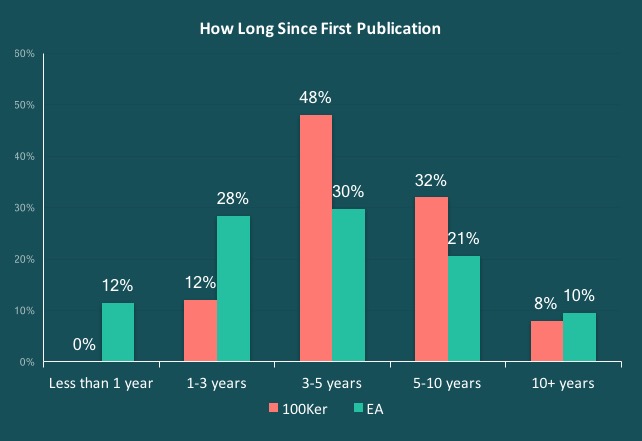
Financially successful authors wrote more, with an average of 13.5 books published, and an average of 31 hours writing per week. Broken down by day, that’s an average of more than 4 hours writing per day. Compare that to the average of 7.4 books published for emerging authors, and an average of 16 hours per week writing, which puts them at less than half the hours spent writing per day than the successful authors. Of those who earn $100k in annual sales, 88% have been writing for more than 3 years, compared to 59% for emerging authors. This gives the successful authors time to gain experience and to build an audience.

Further, successful $100k authors 100kers have on average 30.3 books in their catalog, while emerging authors had around 7 on average. Even further, $100k authors had up to 63 books, and a minimum of 7 in their backlist. Again, writing more lends itself to finishing more books, which can be published.

Financially successful authors have professionally designed covers, with 68% of them having spent >$100 on book design. They typically have professionals design their book cover. Now, I think this relates more to indie authors, but still, even if you plan on going the traditional route, make sure your cover is professional and eye-catching. Think of how a book catches your eye and entices you to buy it. Chances are, it’s not just the cover blurb that draws you in. Here’s what readers want in a cover. Here’s how to use science to create your best cover.

Financially successful authors have their manuscript professionally edited. You may write, and you may write well, but having another set of professional eyes is key. More than half of the successful authors surveys spent $100-$500 on professional editing services, and 32% spent $500 or more. 

Financially successful authors write in popular genres. They also believe in free promotion, where they have at least one title that is permafree. That is, one of their books is always available for free. They also handle their own marketing, though some (45%) hire help. For both 100kers and Emerging Authors, over 90% of them report doing their marketing themselves. The only difference is that 100kers can hire some help. Here are some marketing tips.  

Do you have any other sources on how authors can maximize their earnings? Share it in the comments below!

Writing is Rewriting

I have written books before–none published as yet, but I’m working on that.

One thing I’ve learned–you can edit your book literally 20 times, and still not have it the way you want it to be. I have experience in this. I revised a manuscript some years back so many times, I ended up with 20 edits, and still wasn’t happy with the way the story flowed, especially since I have written the book as part of a series, and had finished the series in first-draft mode. Every time I sat down to the books to edit, I cringed. Every. Single. Time.

And each revision brought me to the thought, “Ok, I’m done now. It’s as good as it’s going to be at this point.”

But that’s the thing, it’s as good as it’s going to be “at this point.” Six months from now is not “as this point.” It’s six months from this point. And six months makes a huge difference in your perspective on your manuscript and on how to edit it.

Michael Crichton said:

“Books aren’t written—they’re rewritten. Including your own. It is one of the hardest things to accept, especially after the seventh rewrite hasn’t quite done it.”

He’s right. You can have a wonderful story, but that doesn’t mean it flows well and that the technicalities of writing are what they should be. Books are rarely written in first-draft mode and published as is, and become bestsellers. They have to be rewritten, and rewritten, and rewritten, and rewritten again.

So how do you edit your book? Each author has their own method of madness, but many would agree that these steps are critical:

  1. Keep your hands to yourself.

It’s typically a good idea to let your book sit for a while, at least a week, preferably a few months. This gives you a chance to forget about some details, get a fresher perspective, gain new experiences in the time being, and work on other projects. Resist the urge to set fingers to keyboard and begin the editing process.

Distancing yourself is one of the best things you can do when editing your manuscript.

  1. Eye candy.

Give yourself a chance to read through your manuscript, not with the intent of editing it immediately, but to refresh your mind on the story’s details. Sometimes, you’ll find that you wrote something in a scene, but then never used, so it was wasted or irrelevant to your story arc. You can keep a track of details and notes, but don’t worry about editing things right now. You’re a reader here, not a (re)writer.

  1. 12’s a charm.

Write a bunch of short synopses of your book—and write 12 of them. Getting a different perspective on your book each time can help you focus on the story itself, especially if you are writing fiction. The goal here is to acquaint yourself with different perspectives that all include the core components of your story. I usually try to create a few scenarios—trying to examine several facets of the story. It’s helpful to do this after you’ve distanced yourself from your manuscript for a while, and then have re-read it.

  1. Kill it with fire!

Start rewriting. Focus with fixing sentence structure, ripping out paragraphs, and even entire chapters. Do this mindfully, with the intention of tightening your writing, and fixing major structural issues within your plot. You have have left out key items, or added erroneous or irrelevant ones. The goal here is to excise and seal.

5. You spin me ‘round…

You’re probably going to go through no less than 3-4 revisions, and most likely are going to rewrite about 10 times—and that’s no exaggeration.

6. …like a record, baby…

You’re going to go through editing again. Focus now on tightening, because at this point, you should’ve fixed the major structural inadequacies of your plot. Worry about removing excess words, making scenes more descriptive, improving dialogue.

7. Mirror, mirror, on the wall!

Worry now about polishing your manuscript. Go through and make sure that sentences are reflecting what you want them to reflect. Make sure your writing is a mirror that reflects what your mind’s eyes see.

8. Beta me this.

Send it to workshop buddies, writing buddies, and friends/family members. Have others critique. Make sure you find people who can be both nice but harsh; they won’t sugarcoat their criticisms and tell you it’s all fine, but they won’t be cruel to you and bring you down. Find as many beta readers as you can—the more the better. Yes, too many chefs spoil the plot, but if a bunch of people are saying the same thing, you can be assured that they’re probably right.

9. Waterproof it.

Give your manuscript one more look-through. Make sure everything’s as tight as possible.

10. Find an agent or publisher!

Between the editing steps, you should let your manuscript sit, for at least a few weeks, if not a few months. Rushing through the steps will get you nothing except an manuscript that stays rough.


*Note: This article was originally published on January 13, 2016. 

Show me the glint of light

“Don’t tell me the moon is shining; show me the glint of light on broken glass.”—Anton Chekhov

Descriptions make or break writing. There’s nothing worse than reading a book, and being pulled out of the story by a bland description that seems more passive than active.

One word of advice that I’ve seen multiple times, and have experienced both as a reader and as a writer: the best writing is not about action or character development; it’s about how you are able to make music sing from the words that you write.

Don’t tell me that the violinist played a superb piece; show me how she made the audience cry and find goosebumps on their arms listening to her play.

*Note: This article was originally published on January 17, 2016. 

8 Middle Eastern-Inspired Fantasy Reads

The current book I’m writing draws from Middle Eastern folklore and mysticism, namely Jinns. As more books are published that draw from MidEastern themes, I’m devouring them as soon as I can. Not only for ideas for my books, but because of my Middle Eastern heritage: I love seeing my culture represented in literature that includes the mysticism, folklore, and fables! What a beautiful way to honor a rich and cultured history!

The Golem and the Jinni by Helene Wecker

Chava is a golem, a creature made of clay, brought to life by a disgraced rabbi who dabbles in dark Kabbalistic magic and dies at sea on the voyage from Poland. Chava is unmoored and adrift as the ship arrives in New York harbor in 1899.

Ahmad is a jinni, a being of fire born in the ancient Syrian desert, trapped in an old copper flask, and released in New York City, though still not entirely free.

Ahmad and Chava become unlikely friends and soul mates with a mystical connection. Marvelous and compulsively readable, Helene Wecker’s debut novel The Golem and the Jinni weaves strands of Yiddish and Middle Eastern literature, historical fiction and magical fable, into a wondrously inventive and unforgettable tale. 

The Map of Salt and Stars by Zeyn Joukhadar

The story of two girls living eight hundred years apart—a modern-day Syrian refugee seeking safety and a medieval adventurer apprenticed to a legendary mapmaker.

It is the summer of 2011, and Nour has just lost her father to cancer. Her mother, a cartographer who creates unusual, hand-painted maps, decides to move Nour and her sisters from New York City back to Syria to be closer to their family. But the country Nour’s mother once knew is changing, and it isn’t long before protests and shelling threaten their quiet Homs neighborhood. When a shell destroys Nour’s house and almost takes her life, she and her family are forced to choose: stay and risk more violence or flee as refugees across seven countries of the Middle East and North Africa in search of safety. As their journey becomes more and more challenging, Nour’s idea of home becomes a dream she struggles to remember and a hope she cannot live without.

More than eight hundred years earlier, Rawiya, sixteen and a widow’s daughter, knows she must do something to help her impoverished mother. Restless and longing to see the world, she leaves home to seek her fortune. Disguising herself as a boy named Rami, she becomes an apprentice to al-Idrisi, who has been commissioned by King Roger II of Sicily to create a map of the world. In his employ, Rawiya embarks on an epic journey across the Middle East and the north of Africa where she encounters ferocious mythical beasts, epic battles, and real historical figures.

An Ember in the Ashes by Sabaa Tahir

Laia is a slave. Elias is a soldier. Neither is free.
 
Under the Martial Empire, defiance is met with death. Those who do not vow their blood and bodies to the Emperor risk the execution of their loved ones and the destruction of all they hold dear.
 
It is in this brutal world, inspired by ancient Rome, that Laia lives with her grandparents and older brother. The family ekes out an existence in the Empire’s impoverished backstreets. They do not challenge the Empire. They’ve seen what happens to those who do.
 
But when Laia’s brother is arrested for treason, Laia is forced to make a decision. In exchange for help from rebels who promise to rescue her brother, she will risk her life to spy for them from within the Empire’s greatest military academy.
 
There, Laia meets Elias, the school’s finest soldier—and secretly, its most unwilling. Elias wants only to be free of the tyranny he’s being trained to enforce. He and Laia will soon realize that their destinies are intertwined—and that their choices will change the fate of the Empire itself.

A Torch Against the Night by Sabaa Tahir

Elias and Laia are running for their lives. After the events of the Fourth Trial, Martial soldiers hunt the two fugitives as they flee the city of Serra and undertake a perilous journey through the heart of the Empire.

Laia is determined to break into Kauf—the Empire’s most secure and dangerous prison—to save her brother, who is the key to the Scholars’ survival. And Elias is determined to help Laia succeed, even if it means giving up his last chance at freedom.

But dark forces, human and otherworldly, work against Laia and Elias. The pair must fight every step of the way to outsmart their enemies: the bloodthirsty Emperor Marcus, the merciless Commandant, the sadistic Warden of Kauf, and, most heartbreaking of all, Helene—Elias’s former friend and the Empire’s newest Blood Shrike.

Bound to Marcus’s will, Helene faces a torturous mission of her own—one that might destroy her: find the traitor Elias Veturius and the Scholar slave who helped him escape…and kill them both.

A Reaper at the Gates by Sabaa Tahir

Beyond the Empire and within it, the threat of war looms ever larger.

The Blood Shrike, Helene Aquilla, is assailed on all sides. Emperor Marcus, haunted by his past, grows increasingly unstable, while the Commandant capitalizes on his madness to bolster her own power. As Helene searches for a way to hold back the approaching darkness, her sister’s life and the lives of all those in the Empire hang in the balance.

Far to the east, Laia of Serra knows the fate of the world lies not in the machinations of the Martial court, but in stopping the Nightbringer. But while hunting for a way to bring him down, Laia faces unexpected threats from those she hoped would aid her, and is drawn into a battle she never thought she’d have to fight.

And in the land between the living and the dead, Elias Veturius has given up his freedom to serve as Soul Catcher. But in doing so, he has vowed himself to an ancient power that will stop at nothing to ensure Elias’s devotion–even at the cost of his humanity.

Alif the Unseen by G. Willow Wilson

In an unnamed Middle Eastern security state, a young Arab-Indian hacker shields his clients—dissidents, outlaws, Islamists, and other watched groups—from surveillance and tries to stay out of trouble. He goes by Alif—the first letter of the Arabic alphabet, and a convenient handle to hide behind. The aristocratic woman Alif loves has jilted him for a prince chosen by her parents, and his computer has just been breached by the state’s electronic security force, putting his clients and his own neck on the line. Then it turns out his lover’s new fiancé is the “Hand of God,” as they call the head of state security, and his henchmen come after Alif, driving him underground.

When Alif discovers The Thousand and One Days, the secret book of the jinn, which both he and the Hand suspect may unleash a new level of information technology, the stakes are raised and Alif must struggle for life or death, aided by forces seen and unseen.

A Thousand Nights by E.K. Johnston

Lo-Melkhiin killed three hundred girls before he came to her village, looking for a wife. When she sees the dust cloud on the horizon, she knows he has arrived. She knows he will want the loveliest girl: her sister. She vows she will not let her be next.

And so she is taken in her sister’s place, and she believes death will soon follow. Lo-Melkhiin’s court is a dangerous palace filled with pretty things: intricate statues with wretched eyes, exquisite threads to weave the most beautiful garments. She sees everything as if for the last time. But the first sun rises and sets, and she is not dead. Night after night, Lo-Melkhiin comes to her and listens to the stories she tells, and day after day she is awoken by the sunrise. Exploring the palace, she begins to unlock years of fear that have tormented and silenced a kingdom. Lo-Melkhiin was not always a cruel ruler. Something went wrong.

Far away, in their village, her sister is mourning. Through her pain, she calls upon the desert winds, conjuring a subtle unseen magic, and something besides death stirs the air.

Back at the palace, the words she speaks to Lo-Melkhiin every night are given a strange life of their own. Little things, at first: a dress from home, a vision of her sister. With each tale she spins, her power grows. Soon she dreams of bigger, more terrible magic: power enough to save a king, if she can put an end to the rule of a monster.

Fatma: A Novel of Arabia by Raja Alem

Fatma, an Arabian peasant girl, unwittingly embarks upon a strange journey of transformation the day her father marries her off to a snake handler with a sideline in potions brewed from venom. When Fatma is bitten by one of the snakes, she is changed from an innocent girl into an overpoweringly sensuous woman with a mysterious talent for controlling her husband’s snakes and an ability to travel with them into realms beyond ordinary human experience.” “Journeying into the Netherworld with her snakes, Fatma meets Prince Taray, a melancholoy warrior-hero. She and Taray bewitch each other and struggle toward union in rapturous rituals during which, among other things, Fatma alternately bursts into flames and melts into golden liquid.” Resonating with ritual and mystery, Fatma is a tale of one woman’s path to ecstasy – an enraptured vision of enchantment in this world and fulfillment in another. 

*Cover image from Graphic Art News: http://www.graphicart-news.com/amazing-arabic-graffiti-collection-in-a-book/#.Xa3qsOdKjxg